It is a Friday afternoon in a Silicon Valley coworking space, and the atmosphere shifts in a heartbeat. A notification pings across a Slack channel, delivering a sudden notice of redundancy alongside a polished slide deck detailing the rollout of new AI agents. In an instant, seasoned developers and operations managers who spent years cultivating deep domain expertise are replaced by a chatbot interface. The transition is framed as an evolution, but for those on the ground, it feels like a clinical erasure of human institutional memory.
The Mathematics of Displacement
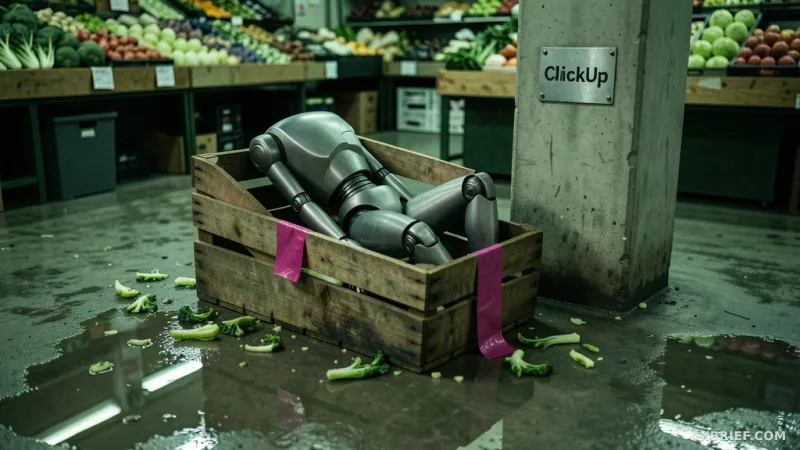
ClickUp recently executed a workforce reduction of 22 percent, a move that transcends simple cost-cutting. The company explicitly stated its intention to replace human roles with AI agents, signaling a shift where artificial intelligence is no longer just a productivity tool but a direct substitute for personnel. This is not an isolated incident but a symptom of a broader industry contagion. The scale of layoffs projected for 2026 has already begun to approach the total figures seen throughout the entirety of 2025, suggesting that the restructuring of the tech labor market is accelerating far faster than previously anticipated.
The Delusion of AI Psychosis
This trend has prompted Aaron Levie, the founder of Box, to coin a term for the current executive climate: AI Psychosis. Levie describes this state as a form of over-immersion where decision-makers, detached from the actual context of daily operations, believe that AI can seamlessly replace human intelligence without loss of quality. The danger of AI Psychosis lies in the erasure of domain knowledge. When a company replaces a veteran employee with an agent, it does not just lose a set of tasks; it loses the intuitive understanding of why those tasks are done and the nuanced judgment required to handle edge cases that no training set can predict.
This disconnect between AI capability and user necessity is already manifesting in the consumer market. Google recently altered its search experience to force AI-generated responses onto users, prioritizing synthesized answers over traditional links. The reaction was swift and negative. Users, frustrated by the slowed access to raw information and the forced nature of the AI interface, began migrating to DuckDuckGo. The surge in installations for the privacy-focused search engine serves as a real-world rebuttal to the belief that more AI is always better. It proves that when AI is forced into a workflow without regard for the user's actual intent, it creates friction rather than efficiency.
As automation accelerates, the human intuition that defines a product's competitive edge is evaporating. The companies that survive this transition will be those that can distinguish between routine tasks and the core value provided by human experts, ensuring that the intellectual moat of domain expertise is preserved rather than automated away.
The ultimate survival of a tech firm now depends on its ability to protect the human experts that AI cannot replicate.