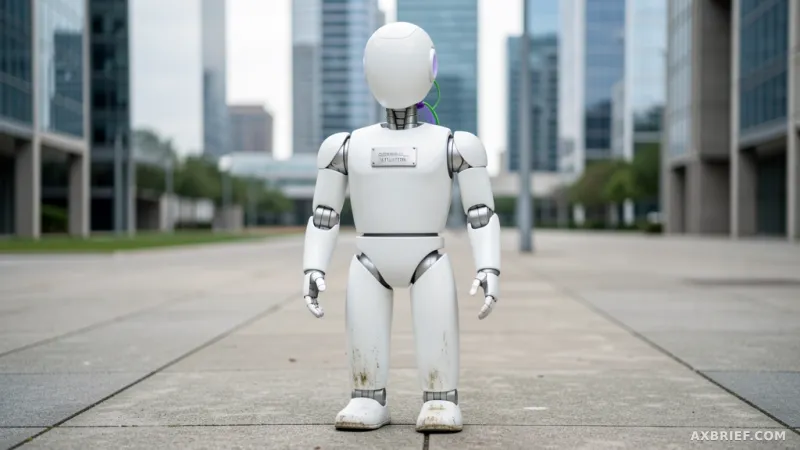
The artificial intelligence industry is currently grappling with the embodiment gap. While large language models have mastered the art of digital conversation and code generation, the transition from a cloud-based brain to a physical body remains the most difficult frontier in robotics. For years, the bottleneck has been data collection; training a robot to navigate a room or manipulate an object requires thousands of hours of expensive, slow, and often dangerous real-world trials. This week, the momentum is shifting toward a different strategy: teaching AI the laws of physics and intuition through the lens of virtual environments before they ever touch a physical motor.
The Financial Surge of General Intuition
New York-based AI startup General Intuition is currently navigating a funding round that reflects this strategic pivot, seeking a pre-money valuation of $6 billion. The investor interest is significant, with the round reportedly oversubscribed. New participants include Valor Equity Partners, Point72 Ventures, and Seven Seven Six, joining existing backers Khosla Ventures and General Catalyst. The speed of this valuation climb is nearly unprecedented in the current market. Only a few weeks ago, the company secured $320 million at a valuation of $2.3 billion. In a matter of days, the perceived value of the company has more than doubled.
This capital infusion is earmarked for a specific technical objective: the refinement of general models for robotic embodiments. General Intuition intends to scale its computing infrastructure and aggressively expand its specialized engineering headcount. To handle the massive computational load required to bridge the gap between virtual training and physical execution, the company has established a strategic partnership with CoreWeave, utilizing their specialized GPU cloud infrastructure to power its model training pipelines.
From Gaming Clips to Physical Intuition
The catalyst for this valuation jump is not a new architecture, but a unique data moat. General Intuition was spun off in October of last year from Medal, a video game clip sharing platform founded by CEO Pim de Witte. This origin story provides the company with an asset that most robotics firms lack: hundreds of millions of hours of gameplay footage paired with action labels. These labels are precise records of exactly which buttons a human player pressed and when, mapped directly to the visual outcome on the screen.
This approach transforms the way physical AI learns. Rather than training a robot via trial and error in a warehouse, General Intuition uses these action labels to instill a sense of intuition in the model. According to investor Vinod Khosla, this allows the AI to generalize tasks it was never explicitly taught, enabling it to understand spatial and temporal relationships. The goal is to move beyond simple command-following and instead create a general AI agent capable of navigating and interacting with the physical world based on a learned intuition of cause and effect.
This shift is also evident in the composition of the investor pool. Valor Equity Partners, widely known for its early bet on SpaceX, is making its first foray into AI research labs with this investment. This suggests a broader macroeconomic trend where capital is migrating away from pure-play LLMs and toward embodied AI—systems that can actually perform work in the physical realm.
For developers and engineers in the robotics space, this signals a fundamental change in the cost structure of data acquisition. The risk and expense of physical data collection are being mitigated by the use of high-fidelity virtual data. The critical technical challenge has now shifted from how to collect data to how to achieve a seamless transfer of learning from a virtual environment to a physical robot.
Success in this sector will no longer be measured by the number of parameters in a model, but by the accuracy of the sim-to-real transfer. The moment General Intuition demonstrates a general AI agent performing complex, unscripted tasks in a real-world environment will serve as the definitive signal for the arrival of practical, scalable robotics AI.