For years, the interaction between humans and smart speakers has felt less like a conversation and more like a coding exercise. Users have lived through the frustration of the rigid voice command, where a single misplaced word or a slight deviation from a pre-defined phrase resulted in the dreaded I am sorry, I do not understand that. This friction created a psychological barrier, forcing users to adopt a specific robot grammar just to turn off a living room light or set a timer. The tension lay in the gap between how we actually speak and how machines were programmed to listen.
The Hardware and the Premium AI Ecosystem
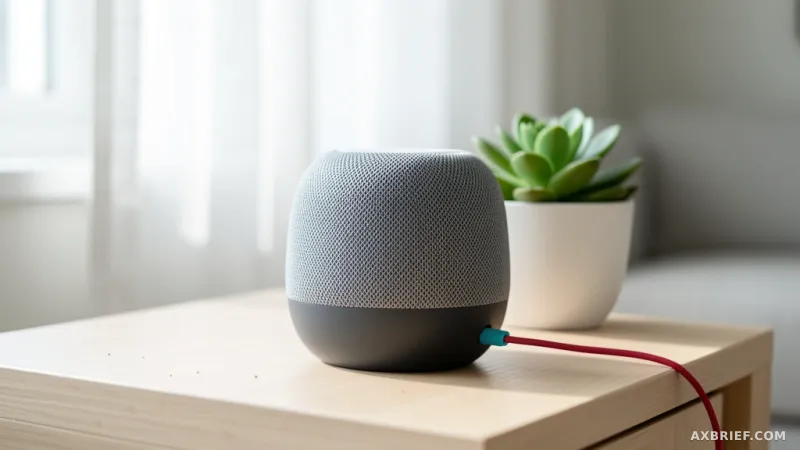
Google is attempting to close this gap with the unveiling of a dedicated Google Home speaker powered by Gemini. Priced at $99.99, this device is not merely a speaker with an AI app layered on top, but the first audio hardware specifically engineered to optimize the Gemini model's capabilities. The hardware design reflects a shift toward ambient integration, featuring a round silhouette wrapped in 3D-knit textiles intended to blend into home furniture. To solve the invisibility of AI processing, Google integrated a ring light at the base of the device. This light serves as a real-time status indicator, shifting its visual state to signal when the device is listening, when it is thinking through a complex response, and when it is actively speaking.
Beyond the hardware, Google is introducing a new monetization layer called Google Home Premium. This subscription plan is available for $10 per month or $100 per year. Subscribers gain access to Gemini Live, a feature that enables seamless, human-like dialogue. This allows the speaker to move beyond simple task execution and into the realm of complex reasoning. For instance, the AI can now analyze activity logs from Nest cameras and provide concise summaries of what happened in the home, transforming raw surveillance data into actionable intelligence. The device is currently available for pre-order and is scheduled to begin sequential shipping by the end of this month.
From Command Controllers to Contextual Agents
To understand why this shift matters, one must look back to September 2020 and the release of the Nest Audio. For the last four years, the standalone smart speaker has functioned primarily as a remote control for the Internet of Things. It was a gateway to trigger a sequence of events: play a song, dim the lights, or check the weather. The intelligence was binary; the command was either recognized or it was not. The Gemini-powered speaker represents a fundamental departure from this controller model, moving instead toward an agentic model.
The core difference lies in the handling of linguistic fluidity. In previous generations, if a user changed their mind halfway through a sentence, the system would typically crash or execute the first half of the command incorrectly. The new Gemini integration supports real-time correction. If a user begins a request and then pivots or corrects a detail mid-sentence, the model tracks the context and adjusts the intent without requiring the user to start over. This is paired with a multi-step request capability, allowing users to bundle complex, multi-stage instructions into a single natural language utterance.
Further enhancing this is the Continued Conversation feature. By keeping the microphone active for a short window after a response, the speaker eliminates the need for the user to repeat the OK Google wake word for every follow-up question. This removes the rhythmic interruption of traditional voice assistants, allowing for a bidirectional flow of information. With 10 new voice options, the interaction moves away from a utility-based transaction and toward a relationship-based interaction. The machine is no longer demanding that the human speak its language; the machine is finally learning to speak ours.
This transition marks the end of the era where users had to adapt to the limitations of the interface. By prioritizing contextual awareness over keyword matching, Google is redefining the smart speaker as an active participant in the home rather than a passive tool.