Walk into any modern gym, and you will see an increasing number of seniors lifting weights with a singular focus: maintaining muscle mass. For decades, the medical consensus has viewed the loss of muscle volume, known as sarcopenia, as the primary enemy of aging. The logic seems intuitive that if we can stop the shrink, we can stop the decline. However, a critical gap exists between the physical volume of a muscle and its actual biological performance. The community of aging researchers is now discovering that the pursuit of size might be masking a deeper, more dangerous degradation of cellular quality.
The Mechanism of Artificial Muscle Preservation
To investigate the tension between muscle quantity and quality, researchers conducted a precision study using two distinct groups of male mice. The first group consisted of young mice aged 4 to 6 months, while the second group comprised middle-aged mice aged 14 to 16 months. The study compared wild-type (WT) mice, which served as the normal control group, against knockout (KO) models where the ATF5 gene, a key regulator of muscle proteins, was completely removed.
The data revealed a striking result regarding muscle volume. In the middle-aged KO mice, the inevitable muscle wasting typically associated with aging was significantly suppressed. These mice maintained a muscle mass that far exceeded that of their WT counterparts. This preservation occurred because the absence of ATF5 inhibited the rise of major regulatory factors that normally trigger the breakdown of muscle proteins. By lowering the overall protein turnover rate, the KO models effectively froze their muscle mass in place, preventing the atrophy that usually defines the aging process.
The Zero-Sum Game of Mitochondrial Health
While the KO mice appeared physically robust, their internal biological markers told a different story. When the researchers shifted their focus from volume to function, the results reversed. Middle-aged ATF5 KO mice exhibited significantly higher levels of muscle fatigue compared to the WT group. This functional collapse was driven by an accelerated production of reactive oxygen species (ROS), the volatile molecules responsible for cellular damage and oxidative stress.
The failure originated in the mitochondria, the energy powerhouses of the cell. Under conditions of rapid muscle contraction, the KO mice showed a suppressed expression of CHOP and ATF4, which are essential transcription factors that manage the Integrated Stress Response (ISR) and the Mitochondrial Unfolded Protein Response (UPRmt). More critically, the absence of ATF5 led to a decrease in LonP, a protease responsible for degrading damaged proteins within the mitochondria. This created a severe proteomic imbalance between proteins derived from the mitochondria and those derived from the nucleus.
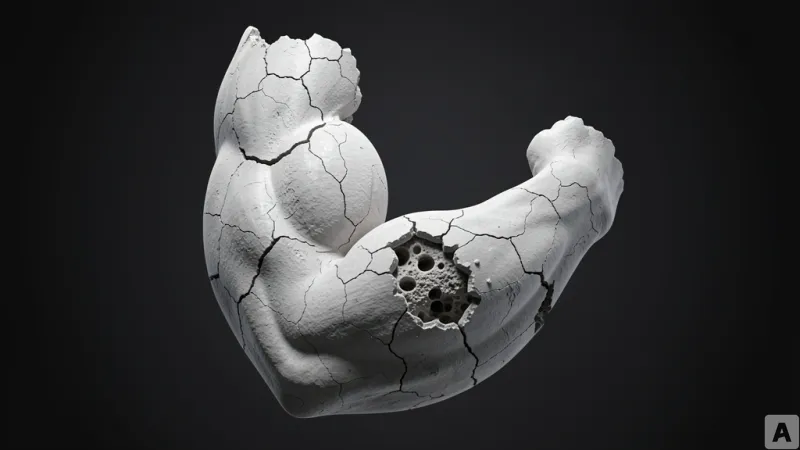
This reveals a biological zero-sum game. ATF5 does not simply manage muscle size; it orchestrates a trade-off. The protein intentionally allows for some loss of muscle mass to prioritize Mitochondrial Quality Control (MQC). By sacrificing volume, ATF5 ensures that the remaining muscle is efficient, resilient, and capable of sustaining energy production. When ATF5 is removed, the muscle keeps its size but loses its soul. The mitochondria become cluttered with dysfunctional proteins, the cell loses its ability to respond to stress, and the resulting muscle is a hollow shell—large in volume but fragile in endurance.
This discovery fundamentally challenges current strategies for treating sarcopenia. Many therapeutic approaches aim to inhibit the pathways that cause muscle loss to keep patients mobile. However, if those pathways are governed by ATF5, inhibiting them could be catastrophic. Attempting to force the maintenance of muscle mass by suppressing ATF5 would likely result in muscles that look healthy on a scan but fail during actual physical exertion. The risk is a total collapse of muscle quality in exchange for a superficial increase in size.
True longevity depends on the quality of the cellular engine rather than the size of the chassis.