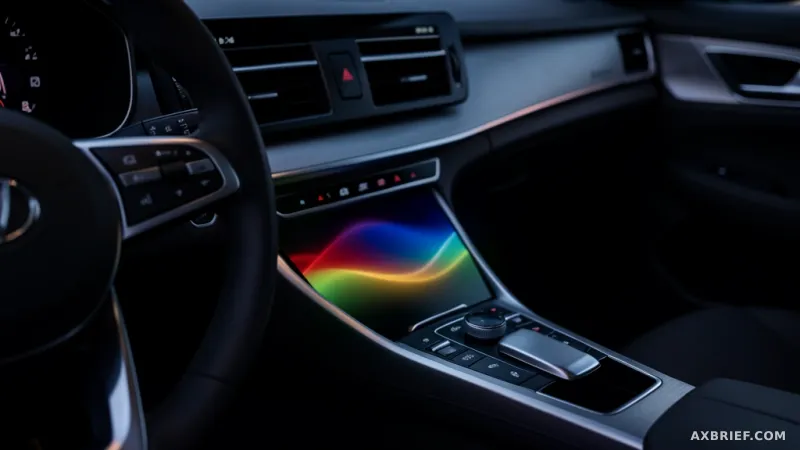
The morning commute usually involves a repetitive dance of tactile friction. Drivers frequently take their hands off the wheel to pinch, zoom, and tap through navigation menus or struggle to dictate a text message into a system that fails to understand a slight deviation in phrasing. For years, the industry standard for in-car voice control has been a rigid set of command-and-control triggers that require the user to speak the language of the machine rather than the machine speaking the language of the user.
The Scale of Gemini's Automotive Rollout
Google announced last Thursday that it is beginning the sequential rollout of Gemini into vehicles equipped with Google built-in. This transition is not a mere feature update but a fundamental replacement of the legacy Google Assistant with a large language model designed for more fluid, complex interactions. The scale of the initial deployment is significant, with General Motors confirming that Gemini will be integrated into approximately 4 million vehicles. This rollout covers Cadillac, Chevrolet, Buick, and GMC models from the 2022 model year onward.
While the General Motors partnership provides the immediate volume, Google intends for this to be a broader ecosystem expansion. The company is positioning Gemini to be the intelligence layer for all compatible vehicles utilizing the Google built-in platform. The rollout begins with English language support in the United States, with plans to expand to additional regions and languages over the coming months.
From Rigid Commands to Contextual Intelligence
The shift from Google Assistant to Gemini represents a move from a decision-tree architecture to a generative one. Previously, requesting a destination or a song required specific syntax; if the driver deviated from the expected command structure, the system typically failed. Gemini changes this dynamic by analyzing intent and context. For instance, a driver can now ask for a restaurant recommendation along their current route specifically requesting outdoor seating. Gemini does not simply provide a list of names; it synthesizes data from Google Maps to provide real-time insights on parking availability and menu details.
This capability is further enhanced by Gemini Live, which enables a continuous, back-and-forth dialogue. By initiating the system with Hey Google, let’s talk, the vehicle transforms from a tool into a collaborative partner. This allows drivers to brainstorm ideas or engage in learning sessions while driving, moving away from the traditional one-off query and response pattern. The tension between driver distraction and utility is addressed here by shifting the interaction from visual screen-dependence to a high-fidelity auditory experience.
Beyond navigation, the integration deepens the connection between the vehicle and the user's broader digital life. Gemini handles climate control, music curation, and the summarization of incoming messages with hands-free responses. The roadmap for future updates includes tighter synchronization with Gmail, Google Calendar, and Google Home, effectively turning the car into a mobile node of the user's smart home and productivity suite.
Automotive software is moving away from static command hierarchies toward an era of proactive, conversational AI.