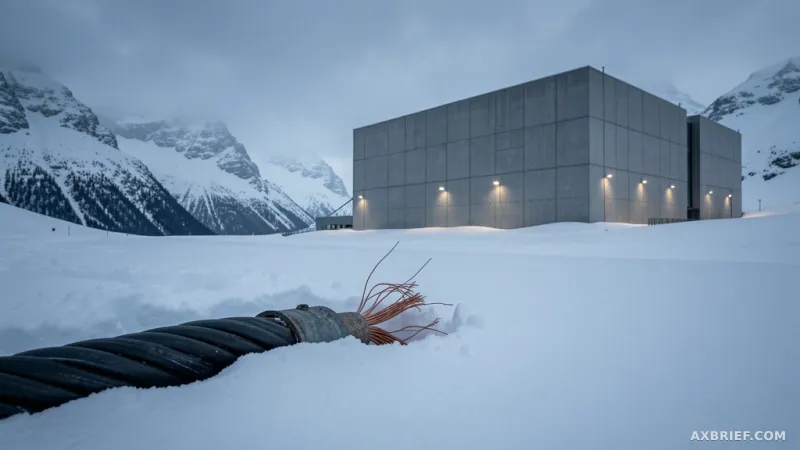
For decades, the serene shores of Lake Tahoe have served as the ultimate sanctuary for Silicon Valley's elite, a place where the architects of the digital age retreat to escape the noise of the industry they built. But the physical reality of that industry is now encroaching on the sanctuary. Residents and second-home owners are discovering that the very intelligence they are engineering in the cloud requires a terrestrial sacrifice: the electricity that keeps their lights on.
The 22GW Surge and the Grid Realignment
Liberty Utilities has announced it will terminate its power supply agreement with NV Energy by May 2027. While the official narrative from both companies suggests this termination was a long-planned transition, the underlying data reveals a more aggressive catalyst. NV Energy is currently facing a staggering surge in power load requests that have surpassed 22GW. To put this number into perspective, the total power demand from the data centers requesting access is more than 40 times the peak power consumption of the entire Lake Tahoe region.
This is not an isolated incident of local mismanagement but part of a broader regional hunger for energy. In neighboring Utah, a massive data center development spanning 40,000 acres recently received approval from the county commission. Once fully operational, this single complex is projected to consume up to 9GW of power. This figure is more than double the current total power usage of the entire state of Utah, which stands at 4GW. The sheer scale of these requirements is fundamentally altering the economics of energy in the American West, turning electricity from a utility into a scarce, high-value commodity.
This volatility is further exacerbated by a precarious global energy market. Geopolitical instability, including the Trump administration's strategic decisions regarding Iran, has injected significant uncertainty into energy supply chains. For a community like Lake Tahoe, which must now scramble to find a new energy provider, this timing is catastrophic. The convergence of geopolitical risk and the insatiable appetite of hyperscalers has created a market where traditional residential consumers are no longer the priority.
The Shift from Software Optimization to Resource Warfare
For years, the AI race was fought in the realm of software. The industry focused on parameter efficiency, pruning, and quantization to squeeze more performance out of existing hardware. However, the battle has now shifted from the virtual to the physical. The primary bottleneck for AI scaling is no longer just the availability of H100 GPUs, but the availability of the megawatts required to run them. We have entered an era of infrastructure warfare where the ability to secure a power grid is a more significant competitive advantage than the elegance of a model's architecture.
This shift has created a brutal new hierarchy of power priority. In the past, utility companies maintained stability through long-term contracts with local communities. Today, the priority is given to the customer willing to pay any price to ensure zero downtime for their clusters. Consequently, traditional consumers in regions like Lake Tahoe are being pushed to the periphery of the grid. Because Lake Tahoe's power lines are more heavily integrated with the Nevada grid than the California grid, the community faces a geographic trap, forced to seek new providers in a market already dominated by the very companies driving the shortage.
There is a profound irony in this displacement. The Silicon Valley executives and venture capitalists who own the luxury estates in Lake Tahoe are the same individuals funding the AI expansion that is now stripping their vacation homes of reliable power. The capital they deployed to accelerate the intelligence revolution has returned to them as a physical cost: higher electricity bills and a precarious energy future. This creates a stark paradox where the designers of the technology are suddenly subject to the externalities of its deployment.
This crisis exposes a growing inequality in the AI era. While the benefits of generative AI are marketed as universal, the social and physical costs—such as the displacement of residential energy—are borne by those who have the least influence over the infrastructure's design. The Lake Tahoe situation serves as a concrete case study in how the expansion of AI infrastructure transfers the burden of progress onto specific geographic regions and social classes.
The competition for AI supremacy has evolved beyond the code; it is now a primitive war for raw resources.