The current gold rush in AI agent development is centered on the dream of a universal operator. Developers are racing to build agents that can navigate any software interface exactly like a human does, using a screen and a cursor. The allure is obvious: if an agent can see a UI, it can theoretically operate any legacy system or third-party SaaS without needing a single line of integration code. This vision-first approach has become the default ambition for many teams attempting to automate complex workflows this year.
The Token Tax of Visual Navigation
Recent data from the agent-benchmark repository reveals a staggering efficiency gap between these vision-based operators and agents that interact via structured APIs. The experiment focused on a standard administrative task: managing customers, orders, and reviews within a react-admin Posters Galore demo panel. To test the vision approach, the researchers utilized browser-use, a library that allows agents to take screenshots of a web browser and simulate clicks and keystrokes.
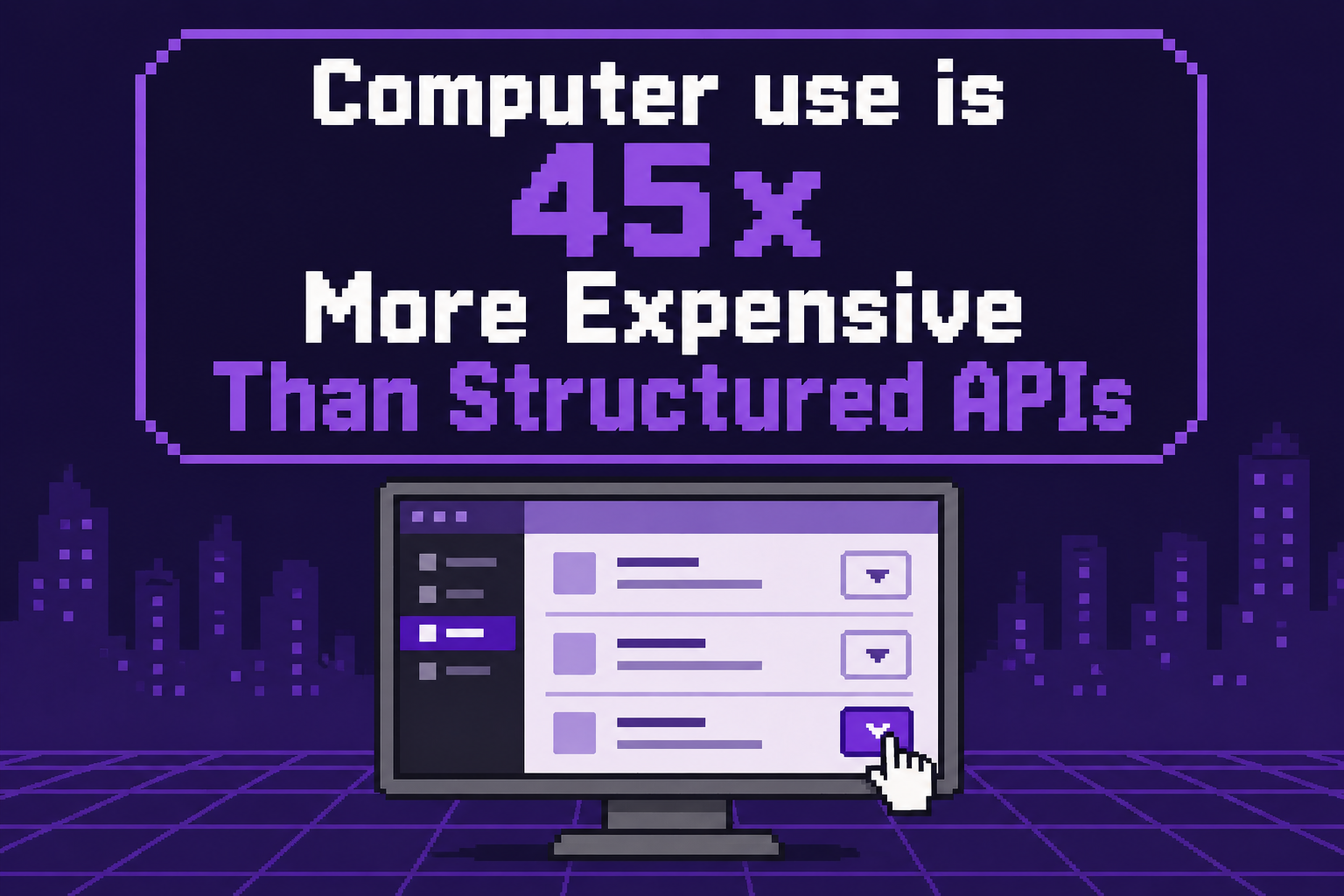
When powered by the Claude Sonnet model, the vision-based agent struggled with the sheer overhead of visual processing. To complete the task, the vision agent required an average of 53 steps, taking 1003 seconds to finish. More critically, the token consumption was immense, totaling 550,976 input tokens. In contrast, the API-based agent, which interacted directly with the application's HTTP endpoints to receive structured data, completed the same task in just 8 calls. The API path took only 19.7 seconds and consumed a mere 12,151 input tokens. This represents a 45-fold increase in token cost and a 50-fold increase in execution time for the vision-based approach.
Beyond the cost, the vision agent exhibited significant reliability issues. Because it relies on visual snapshots, it suffered from a lack of determinism. In several instances, the agent failed to recognize data located below the current scroll line, leading to missed tasks and incomplete workflows. The API agent, by contrast, accessed the full data state regardless of the visual viewport, ensuring a consistent and accurate result every time.
The Interface Bottleneck
To determine if the vision agent's failure was a matter of intelligence or interface, the researchers introduced a 14-step explicit UI walkthrough. This guide provided the agent with a precise map of how to navigate the UI, removing the need for the model to guess the next move. While the guided vision agent successfully completed the tasks, the efficiency gains were negligible. The process still took 14 minutes and consumed approximately 500,000 input tokens.
This result shifts the narrative from model capability to architectural cost. The bottleneck is not the reasoning power of Claude Sonnet, but the medium of communication. Every single step in a vision-based workflow requires the model to process a high-resolution screenshot, which translates into a massive amount of tokens. The agent is essentially re-reading the entire visual state of the application every time it moves the mouse. The API approach eliminates this redundancy by requesting only the specific data needed for the current operation in a lightweight, structured format.
For developers, the traditional argument against API-based agents has been the engineering overhead required to build and maintain those endpoints. However, new tooling is narrowing this gap. Reflex 0.9 introduces an automatic event handler generation feature that allows developers to create API paths for internal tools with significantly less manual effort. By automating the bridge between the UI and the backend, the high engineering cost of API integration is being replaced by a one-time setup that yields permanent operational savings.
Vision-based agents remain a necessary evil for legacy systems where no API exists or for external SaaS platforms where the developer has no control over the backend. But for any internal tool or application where the developer owns the code, the data proves that pixels are the most expensive way to communicate with an AI.