At the Google for Korea conference in Seoul this week, the atmosphere felt less like a product keynote and more like a reunion of the AlphaGo team. Ten years after their AI shocked the world on a Go board, the same researchers are now standing inside factory floors and service counters, talking about hardware. The central theme was not a software update or a new model release. It was something more tangible: what happens when Google's Gemini model stops living in the cloud and starts living inside a machine that moves.
Hassabis on Korea's AI Edge
Google DeepMind co-founder and CEO Demis Hassabis described Korea as the "best restaurant" for AI. His metaphor was deliberate. He argued that Korea's dominant manufacturing infrastructure and hardware engineering are the finest ingredients for software innovation. In his view, Google's AI algorithms — the secret sauce — become globally unbeatable when combined with Korea's hardware ecosystem. The conference backed this up with live demonstrations that showed exactly what that combination looks like.
Gemini Meets the Robot Dog
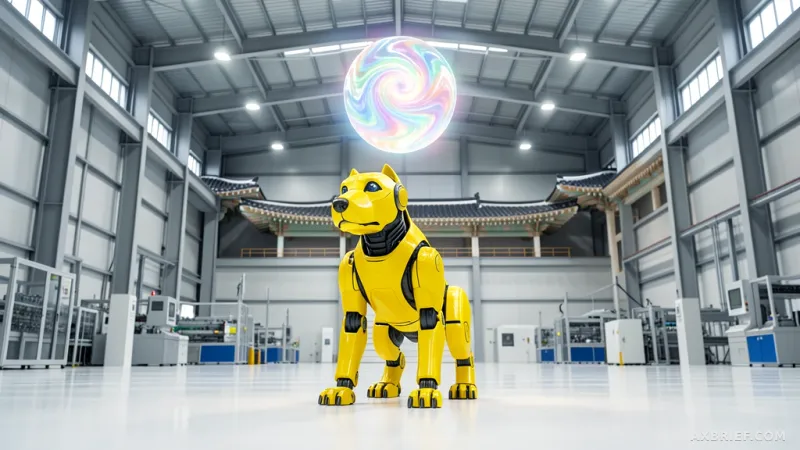
Robots used to follow fixed paths. Now they see and decide. Boston Dynamics' quadruped robot Spot, which Google once owned, was demonstrated on stage with Gemini running onboard. The robot did not just walk a pre-programmed route. It recognized its surroundings, assessed situations, and made decisions in real time — like an AI engineer wearing a hard hat. For developers, this signals a shift: robot control code and large language model reasoning are now fusing at the API level. The robot is no longer a remote-controlled tool; it is an autonomous agent inside a physical environment.
Google's Infrastructure Play for the Ecosystem
Google is not treating this as a one-off demo. The company announced two concrete support structures to sustain the integration. The first is AI Olym, a unified training program for AI talent. The second is the Google AI Campus, a physical space in Korea designed to support AI startups and developers. Both are intended to function as testbeds where local engineers can build field-ready AI solutions using Google's latest models. Google plans to deploy manufacturing-optimized AI models through the campus and solve technical challenges in collaboration with Korean developers.
Korea is no longer just a consumer of AI technology. It is becoming the most important laboratory where Google's AI meets the physical world.