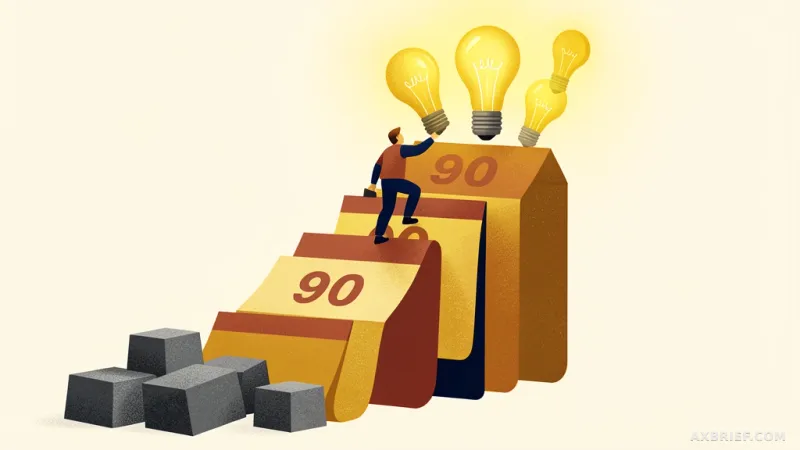
Every morning, the inbox fills with a relentless stream of emails and meeting transcripts, leaving many professionals feeling as though their skill sets are rapidly losing relevance in an AI-driven landscape. Executives at LinkedIn and Microsoft argue that this shift is not merely a change in software, but a fundamental restructuring of how we define professional productivity. In their recent collaborative work, they outline a structured 90-day transition period designed to help individuals move beyond the anxiety of technological disruption and into a state of AI-augmented mastery.
The 90-Day Framework for Task Restructuring
The path to operational efficiency begins with a rigorous audit of your daily responsibilities. The strategy requires breaking down your current workload into 12 core tasks, then categorizing them into three distinct buckets: those that can be fully automated, those that can be streamlined, and those that demand unique human judgment. Ryan Roslansky, CEO of LinkedIn, and Aneesh Raman, Vice President of Economic Opportunity at LinkedIn, emphasize that the goal of this classification is to reclaim time for high-impact, strategic projects. Data supports this urgency; as of 2025, AI-related posts on LinkedIn have surged by 29% year-over-year, signaling that the professional market is aggressively pivoting toward AI-assisted workflows. To initiate this audit, users can leverage Microsoft 365 Copilot with the following prompt:
text
Review my to-do list and identify which tasks could be automated, streamlined, or delegated — and suggest how I could approach each differently. Draft a simple weekly routine to help me build new habits that stick (no more than 15 minutes/day).
Bridging Tool Proficiency and Human Value
Historically, professional competence was measured by how quickly one could master a specific tool. Today, the metric has shifted toward how effectively one can offload repetitive labor to AI to create space for uniquely human contributions. The core competencies that remain beyond the reach of current models—curiosity, creativity, communication, empathy, and courage—must become the primary focus of the modern worker. The strategy involves creating a daily feedback loop where Microsoft 365 Copilot handles the administrative burden of summarizing emails or preparing meeting agendas, allowing the professional to dedicate their cognitive bandwidth to relationship building and strategic planning. To begin automating these daily administrative tasks, you can use this syntax:
Summarize this [email/document/meeting notes] into three key takeaways and two follow-up actions I should take.Ultimately, this 90-day process is not about learning software; it is a strategic maneuver to align your reclaimed time with long-term career objectives. The final phase of this transition requires documenting your AI-driven productivity gains to demonstrate your evolving market value to managers and your professional network. By synthesizing your performance data, you can articulate how your role has shifted from manual execution to high-impact output. You can generate this narrative using the following command:
text
Help me write a short summary of how I’ve used AI to improve my work based on my emails, Teams conversations and work documents. Then turn it into: 1) a first draft of a LinkedIn post I can personalize and share with my network, and 2) three bullet points I can use in a conversation with my manager about my unique skills and how I can apply them to higher-impact work.
Adopting AI is no longer a matter of choosing the right software, but a management strategy that forces a re-evaluation of what work truly matters.