The modern warehouse floor is a study in repetitive strain. For decades, the final stage of the logistics chain—palletizing—has remained one of the most grueling tasks for human workers, requiring the constant lifting and stacking of heavy boxes in a relentless cycle. While basic automation has existed for years, it has often been rigid, requiring extensive manual programming for every new box size or pallet configuration. This week, the industry is shifting toward Physical AI, where robots no longer just follow a script but understand the spatial and physical constraints of their environment in real time.
The Architecture of High-Speed Palletizing
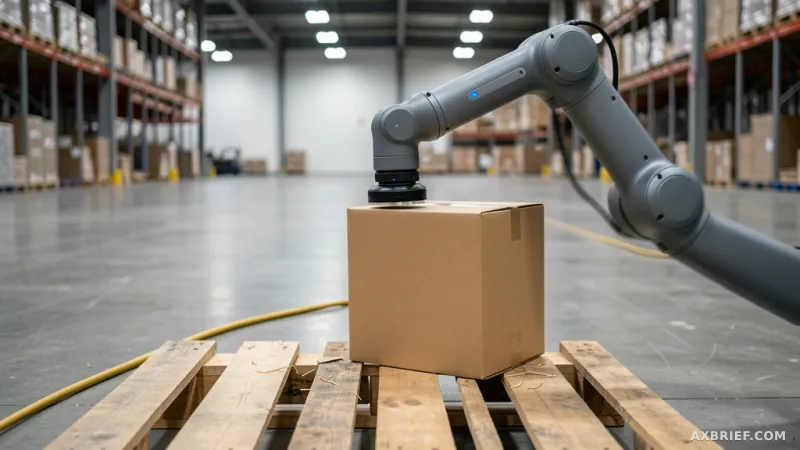
Doosan Robotics is entering this fray with the unveiling of PalletizHD+, an AI-driven palletizing solution designed to eliminate the friction of manual stacking. The system is built upon PalletizOS, a proprietary operating system developed specifically for palletizing tasks. By integrating hardware, software, and user applications into a single ecosystem, Doosan has removed the typical middleware gaps that slow down industrial robot deployment. The result is a system capable of processing up to 11 boxes per minute.
This throughput is achieved through a combination of AI-based pattern generation and a proprietary motion technology called Swift Move. Swift Move optimizes the robot's trajectory before the arm even begins to move, calculating the most efficient path to minimize air time and maximize placement speed. Depending on the configuration, the system can handle multiple boxes simultaneously, which directly increases hourly throughput and significantly shortens the return on investment period for facility managers. The user interface mirrors the simplicity of a smartphone, allowing operators to manage box dimensions, pallet conditions, loading patterns, and overall system health from a single integrated screen. When a user inputs the box and pallet specifications, the AI automatically generates the optimal stacking pattern, removing the need for complex manual coordinate mapping.
From Simple Stacking to Physics-Informed Precision
While moving boxes quickly is a feat of efficiency, the real evolution lies in how the robot perceives the physical world. Doosan Robotics is moving beyond simple pick-and-place operations with the introduction of Scan&Go 2.0. The critical distinction here is the implementation of physics-informed AI combined with 3D vision. Unlike standard AI, which relies purely on data patterns, physics-informed AI incorporates the laws of physics into the learning process. This allows the robot to predict how materials will react under pressure or movement, drastically increasing the stability and accuracy of the arm during complex maneuvers.
This shift in intelligence transforms the robot from a logistics tool into a precision instrument. Doosan is showcasing this capability through specialized solutions for sanding and welding—tasks that require a level of tactile sensitivity and spatial awareness that traditional palletizing robots lack. By extending this intelligence to End-of-Line (EOL) solutions, including box assembly and packaging, the company is attempting to automate the entire final stretch of the production line. This transition from "blind" repetition to "aware" precision represents the core of the Physical AI movement, where the software understands the material properties of the object it is manipulating.
To support this technological push, Doosan Robotics has restructured its global operations to penetrate the North American market more aggressively. The company recently merged its existing US subsidiary with Onexia, creating a unified North American entity. This merger is not merely administrative; it is a strategic move to expand local production capacity and hire specialized talent to support the deployment of PalletizHD+ and Scan&Go 2.0 across US factories and distribution centers. The company will showcase these integrated systems at Automate 2026 in Chicago from June 22 to 25, positioning itself as a provider of a full-stack automation ecosystem.
Doosan Robotics is now bridging the gap between high-speed logistics and high-precision manufacturing through a unified AI framework.