The modern factory floor is a study in rigid precision. For decades, industrial robots have operated on a simple, uncompromising premise: follow a pre-programmed coordinate path with absolute consistency. While this works for high-volume assembly lines, it creates a fragile ecosystem. A single misplaced component or a slight shift in a workpiece's position often results in a catastrophic system halt or a costly collision. The industry has long sought a way to move beyond this binary state of either perfect repetition or total failure, searching for a machine that can feel its way through a task much like a human technician does.
The Hardware of Adaptive Automation
Flexiv is addressing this rigidity with the launch of Enlight, a 7-axis robotic arm designed specifically for environments where variability is the only constant. Unlike traditional arms that rely on external sensors or end-effector force gauges, Enlight integrates multi-dimensional force-torque sensors into every single one of its seven joints. This architecture allows the robot to measure both the force it exerts and the physical pressure it receives from the external environment in real time.
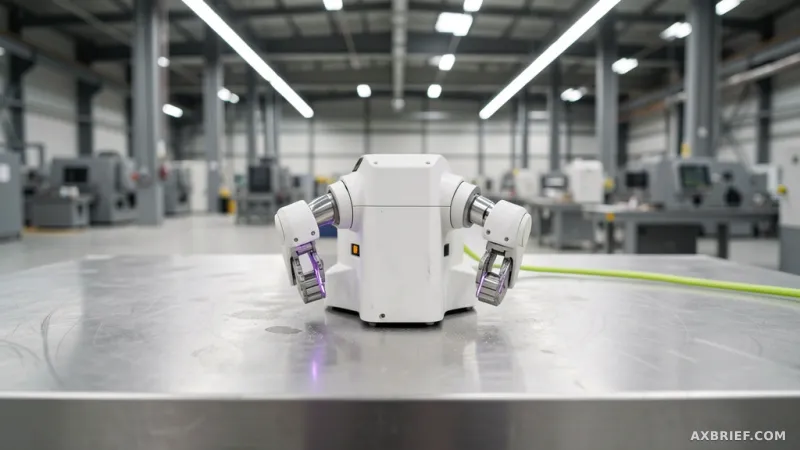
Physically, the Enlight model is built for agility and accessibility. It weighs 15kg and features four joints capable of 720-degree rotation, allowing it to maintain a wide operational range even within highly confined workspaces. According to Suyun Cheng, Chief Robot Scientist at Flexiv, this combination of sensing and mobility makes the system safer and significantly easier to program than legacy industrial robots, particularly in restricted environments where traditional movement patterns would be impossible.
Expanding on this single-arm capability is Mico, a modular dual-arm platform. Mico synchronizes two Enlight arms under a single control architecture, enabling the organic cooperation required for complex, two-handed manipulation. To accommodate different industrial needs, Flexiv offers Mico in four standard configurations: Armor, Core, Plus, and Ultra. This modularity allows operators to scale the hardware based on the specific precision and strength requirements of their workflow.
Bridging the Gap Between Simulation and Reality
The true shift in Flexiv's approach is not just the addition of sensors, but the transition from path-following to adaptive interaction. Traditional robots are essentially blind to the physical resistance they encounter until a limit is reached and an error is triggered. Enlight, however, utilizes whole-body contact sensitivity to recognize complex tactile patterns. By tracking multiple contact points simultaneously and merging this data with advanced vision systems, the robot can adjust its trajectory and force on the fly. It does not just execute a command; it perceives the result of that command and corrects itself.
To prove this capability, Flexiv utilized NVIDIA Isaac Sim to validate the robots' performance before physical deployment. The company focused on high-difficulty tasks, such as the precision manipulation of graphics cards—components that require a delicate balance of force and alignment to seat correctly without damage. By simulating these interactions, Flexiv could refine the robot's adaptive responses in a virtual environment, ensuring that the transition to the physical world was seamless.
This reliance on simulation-based verification highlights a broader trend in embodied intelligence. The goal is no longer to write a perfect script for the robot to follow, but to give the robot the sensory tools to handle an imperfect world. For the end-user, the critical metric for success has shifted. The value of the hardware is now judged by the precision of its force control in unstructured environments and the degree of data alignment between the simulation and the actual deployment.
Founded in 2016 in Shanghai, Flexiv has expanded its footprint to Silicon Valley, Beijing, Munich, and Singapore, positioning itself at the intersection of high-fidelity sensing and simulated validation.
The future of industrial robotics now depends on the narrow gap between a simulated movement and a felt reality.