
The frustration of a song stuck in your head is a universal human experience. You remember a rhythmic fragment or a few nonsensical syllables, but the title and artist remain elusive. For years, the solution involved typing fragmented lyrics into a search bar and scrolling through pages of results, hoping the algorithm could guess your intent. This week, Google decided to demonstrate that this friction is now a relic of the past, not through a technical white paper, but through the high-energy lens of K-pop. By embedding Gemini and Android's latest capabilities into the music video and campaign for LE SSERAFIM's track BOOMPALA, Google is signaling a fundamental shift in how we interact with artificial intelligence.
The Technical Pipeline of the BOOMPALA Experience
The integration begins with the entry point. In the music video, member Huh Yunjin invokes Gemini not by navigating through an app drawer or typing a command, but by long-pressing the smartphone's physical side button. This reduces the friction of AI access to a single tactile gesture. Once active, the interaction moves into natural language processing. When a request for a mood-lifting song is made, Gemini does not simply provide a list of recommendations; it triggers a direct integration with Spotify to play the intro of BOOMPALA. This represents a closed-loop system where the AI understands a vague emotional request and executes a specific function within a third-party application.
The campaign further highlights the evolution of search through the handling of ambiguous queries. When a user asks to find a song that goes boom dalla dalla, Gemini treats the input as more than a literal string of text. The underlying Large Language Model (LLM) calculates the probability of the song based on phonetic patterns, rhythm, and current cultural trends. By analyzing the relationship between these fragmented tokens, the model infers that the user is referring to BOOMPALA. This is a departure from keyword-based indexing, moving instead toward intent-based reasoning where the AI fills in the gaps of human memory.
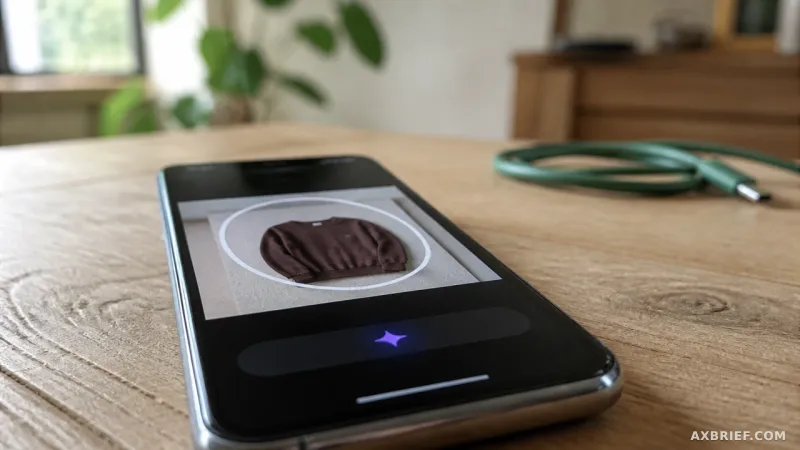
Visual search is handled through Circle to Search, as demonstrated by member Hong Eunchae. When a user circles a piece of clothing on the screen, the system creates a digital mask over the selected area, isolating the pixel data from the rest of the frame. The AI then extracts visual feature points—such as fabric texture, color gradients, and sleeve geometry—and converts them into high-dimensional vector values. These vectors are compared in real-time against Google's massive image database to find the closest mathematical match. This process transforms a complex visual design into a searchable data point without requiring the user to describe the item in words.
From Information Retrieval to Action Agents
The critical distinction in this rollout is the transition from the chatbot paradigm to the action agent paradigm. For the last two years, the primary utility of AI has been information retrieval: you ask a question, and the AI provides a text-based answer. However, the BOOMPALA campaign showcases a workflow where the information step is bypassed entirely. When Gemini identifies a song, it does not tell the user the name of the song and suggest they open a music app; it directly controls the Spotify interface to start the playback. The AI has moved from being a consultant to being an operator.
This shift is powered by multimodal capabilities, where text, audio, and imagery exist in a single organic flow. A user starts with a textual memory of a lyric, moves to an auditory experience of the song, and ends with a visual search for the wardrobe seen in the music video. This cross-modal journey reduces the cognitive load and the number of steps required to move from curiosity to action. The search result is no longer a destination—a webpage or a link—but a catalyst for a physical action, such as purchasing a garment or recreating a look.
Furthermore, the system demonstrates a growing capacity for context awareness. The campaign places Gemini in diverse environments, from the interior of a car to a serene spa and a busy supermarket. In these scenes, the AI suggests tools based on the physical setting. For instance, a request to change the atmosphere in a spa triggers a specific musical curation via Spotify that fits the ambient environment. This indicates that the AI is no longer just processing the prompt, but is calculating the physical and situational context of the user to determine the most appropriate tool for the job.
Google Korea's decision to partner with LE SSERAFIM is a strategic move to lower the psychological barrier to AI adoption. By replacing a technical manual with a lifestyle narrative, Google positions Gemini not as a productivity tool for power users, but as a creative companion for the general public. The collaboration transforms complex features like vector search and multimodal processing into a seamless part of a sophisticated lifestyle. The goal is to move the value proposition of AI from functional convenience to emotional satisfaction, making the technology feel intuitive rather than instructional.
Ultimately, the success of AI integration depends less on the raw power of the algorithm and more on the design of the trigger. By repeatedly showing Gemini being invoked in specific, relatable moments of frustration or inspiration, Google is training users on the behavioral patterns of the action agent era. The focus has shifted from what the AI knows to what the AI can do on the user's behalf.
The era of the AI chatbot is evolving into the era of the invisible assistant. The bridge between a vague thought and a real-world action is finally closing.



