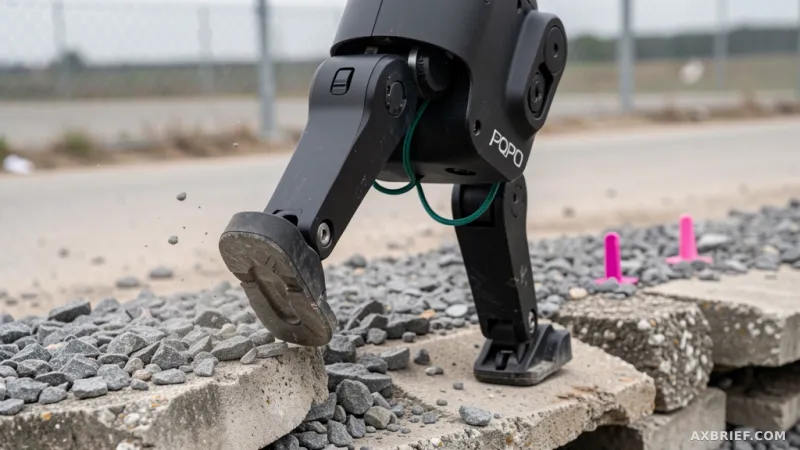
The image of a quadruped robot navigating a pristine laboratory floor is a common sight in modern tech demos. We have seen Boston Dynamics' Spot perform choreographed dances and navigate predictable office environments with eerie precision. However, the moment a robot leaves the polished concrete and encounters the chaotic unpredictability of rough terrain, the challenge shifts from simple locomotion to a complex battle of real-time physics and sensory processing. This gap between controlled environments and the wild is where the current frontier of Physical AI resides, and it is exactly where a group of undergraduate students recently made their mark.
The Technical Gauntlet of ICROS 2026
On July 1, the Daegu EXCO center became the staging ground for the 2nd ICROS 2026 Quadruped Robot Competition. This event served as a high-stakes stress test for 16 teams comprising 40 participants, drawing talent from the Intelligent Robot Innovative Convergence University project and the general public. The competition featured a clash of technical philosophies from several prominent institutions, including Hanyang University ERICA, Kwangwoon University, Pukyong National University, Sangmyung University, and Yeungjin College.
Among these competitors, Team Popotech from the Korea Polytechnic University emerged as the dominant force, securing the grand prize. The team, consisting of students Jeong Jae-hoon, Han Seo-young, Kim Dong-jin, and Yang Ji-eun, focused their efforts on the most volatile aspect of robotics: the autonomous walking algorithm. The judging criteria were rigorous, focusing on three primary pillars: autonomous walking performance across diverse and challenging terrains, the precision of the control technology, and overall hardware reliability. Hardware reliability in this context refers to the robot's ability to operate continuously without mechanical failure or systemic crashes under stress. Popotech achieved the highest overall score by synthesizing a robust control software layer with a chassis capable of enduring the physical toll of unpredictable environments.
The Infrastructure Twist in Physical AI
While the victory of Team Popotech appears to be a triumph of individual student brilliance, the underlying cause is a systemic shift in how robotics is taught. Traditionally, the barrier to entry for high-end robotics has been the prohibitive cost of hardware and the isolation of research silos. The assumption has always been that only well-funded corporate labs or elite research universities with massive budgets could produce robots capable of true autonomous navigation in rough terrain. However, the Popotech victory suggests a different catalyst: the integration of educational infrastructure.
This success is a direct output of the Advanced Field Innovative Convergence University Fostering Project, a strategic initiative driven by the Ministry of Education and the National Research Foundation of Korea. Running from 2021 to 2026 and led by Hanyang University ERICA in collaboration with seven other universities, including Korea Polytechnic University, the project operates on a model of shared resources and joint curricula. By distributing the costs of expensive equipment and research funding across multiple institutions, the project lowered the entry barrier for undergraduate students.
This creates a critical distinction in the development of Physical AI. The 'twist' here is that the ability to implement complex autonomous algorithms is not strictly a function of capital investment, but a function of the pipeline connecting theory to practice. Popotech students did not simply study autonomous walking in a textbook; they utilized a shared educational ecosystem to iteratively test their algorithms against real-world physical constraints. They transformed theoretical control laws into software that allows a robot to perceive a surface, calculate the necessary torque for each joint, and maintain equilibrium without human intervention. The result is a demonstration that undergraduate-level teams can achieve professional-grade reliability when the educational framework prioritizes practical implementation over isolated theory.
This shift indicates that the next leap in robotics will not come solely from larger models or more expensive sensors, but from the democratization of the tools required to bridge the gap between digital intelligence and physical movement. The Popotech case proves that a structured, collaborative academic environment can replicate the R&D capabilities of a corporate lab, provided the students have a direct path to hardware experimentation.
This victory establishes a new practical benchmark for robotics education, proving that the mastery of Physical AI is now accessible to those who can effectively bridge the divide between algorithmic theory and mechanical reality.