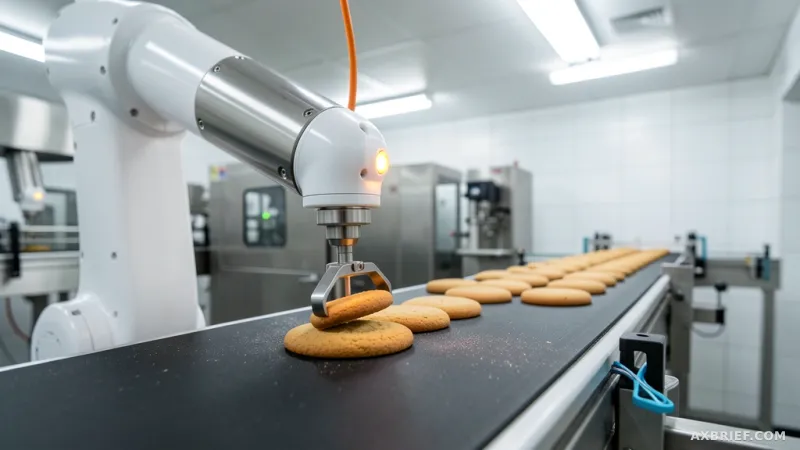
For decades, the gold standard of industrial automation was the automotive assembly line, a choreographed dance of orange robotic arms welding chassis with millimetric precision. But walk into a modern American production facility today, and the scenery is shifting. The sparks of the welding shop are being joined by the sterile, high-speed movements of robotic sorters in food processing plants and the autonomous navigation of logistics hubs. The narrative of American manufacturing is no longer just about building cars; it is about a systemic migration of automation into the essential sectors of the economy.
The Diversification of American Automation
According to the latest industry data, the United States recorded 38,000 industrial robot installations in 2025, marking an 11 percent increase over the previous year. While the automotive sector remains the largest consumer of this technology, its dominance is beginning to plateau. In 2025, the automotive industry deployed 13,500 units, but this figure actually represents a 1 percent decline compared to the prior year. The real story lies in the periphery of the traditional industrial core.
The food and beverage industry has emerged as the primary growth engine, with robot installations surging by 30 percent. By 2025, the food sector's adoption reached approximately 3,000 units, effectively placing it on par with the metal, machinery, and electrical-electronics sectors. This shift indicates that automation is moving beyond the highly structured environments of car manufacturing and into the more complex, variable environments of food production and packaging.
This acceleration is not happening in a vacuum. It is the direct result of two converging economic pressures: the aggressive push for reshoring and a chronic shortage of skilled labor. As companies move production facilities back to US soil to secure supply chains, they are discovering that the human workforce required to operate these plants is missing. The inability to find skilled technicians has forced a pivot toward capital investment in automation to fill the productivity gap. Consequently, the foundation of US robot demand is widening, spreading from the automotive plant to the warehouse and the food processing line.
The Density Gap and the Physical AI Race
When measuring the actual intensity of automation, the global landscape reveals a stark contrast in strategy. Robot density, defined as the number of operating robots per 10,000 manufacturing employees, places South Korea at the top of the world with a staggering 1,220 robots. Germany and Japan follow with 449 and 446 robots respectively. The United States has climbed to 8th place globally with a density of 307, surpassing China, which sits at 166.
However, density does not equal scale. While the US is increasing its efficiency per worker, China is pursuing a strategy of absolute volume. In 2024, China installed 295,000 new robots, accounting for 54 percent of all global installations. The International Federation of Robotics (IFR) estimates that by 2025, China's installation volume will be roughly ten times that of the United States. This is not an accidental surge but a state-mandated objective. Through its 15th Five-Year Plan (2026-2030), China is pivoting its artificial intelligence research toward physical applications, treating robotics as the primary engine for future economic growth.
This creates a tension between the US model of diversified, demand-driven growth and the Chinese model of state-led, mass-scale deployment. The US is focusing on integrating robots into a broader array of industries to solve labor shortages, while China is building a massive infrastructure of physical AI to dominate the global manufacturing footprint. The result is a geopolitical race where the US is fighting to maintain technological leadership in quality and versatility while being overwhelmed by the sheer quantity of Chinese hardware.
In response to this imbalance, the Association for Advancing Automation (A3), the largest automation trade group in North America, has moved from industry advocacy to political lobbying. A3 has proposed a comprehensive national robotics strategy to the US Congress, calling for the establishment of a Federal Robotics Agency and a National Robotics Council. The goal is to synchronize government policy and formalize public-private partnerships. The proposal emphasizes expanded tax incentives for automation and a buy-American policy for robotic technology to insulate the domestic supply chain from foreign dominance.
As the US attempts to institutionalize its robotics strategy, the focus is shifting from simply replacing human tasks to creating a resilient, automated industrial base that can compete with the scale of the East.