Imagine a high-intensity conflict erupting in the middle of the Pacific Ocean. For the United States military, the nearest drone manufacturing plant is not a few miles away, but thousands of miles across an ocean. Every single replacement part, every updated sensor, and every new drone must travel via ship or aircraft, crossing vast distances while exposed to enemy interdiction. In this scenario, the most advanced weapon systems in the world become useless the moment a supply line is severed. The vulnerability is not in the technology of the weapon, but in the geography of its production.
The $82 Million Bet on 24-Hour Production
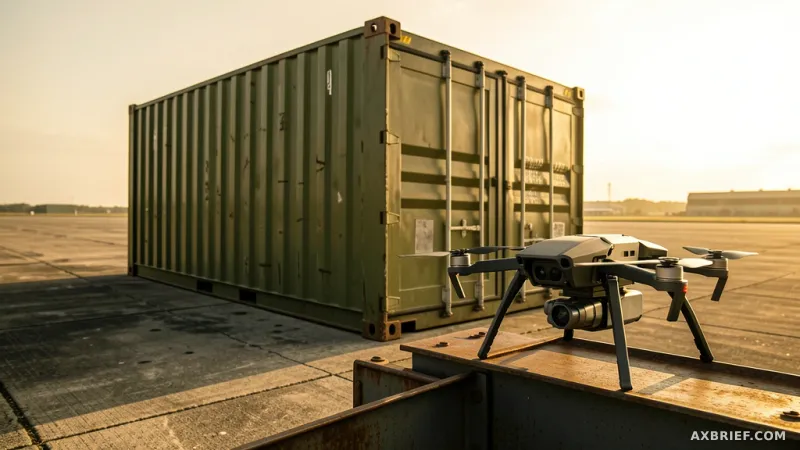
Firestorm Labs is attempting to erase this geographic vulnerability by moving the factory to the fight. The startup recently closed an $82 million Series B funding round led by Washington Harbour Partners, bringing its total cumulative investment to $153 million. The funding round saw participation from a heavy-hitting group of strategic investors, including NEA, Ondas, In-Q-Tel, Lockheed Martin, Booz Allen Ventures, Geodesic, and Motley Fool Ventures. This capital injection is specifically earmarked to accelerate the deployment of xCell, a container-based mobile manufacturing platform designed to produce drone systems in under 24 hours.
At the heart of the xCell unit is a sophisticated integration of industrial hardware. Firestorm Labs has secured a five-year global exclusive agreement with HP to embed their industrial 3D printers within these mobile units. This partnership allows the company to transform a standard shipping container into a fully functional aerospace factory. The output is not limited to a single model; depending on the immediate needs of the commander on the ground, xCell can produce drones configured for reconnaissance, electronic warfare to disrupt enemy communications and radar, or lethal kinetic operations.
The financial commitment from the government reflects the urgency of this capability. Firestorm Labs currently holds a contract with the US Air Force with a maximum ceiling of $100 million, of which $27 million has already been executed. The operational footprint is already expanding, with units deployed to the Air Force Research Laboratory in Rome, New York, and the Air Force Special Operations Command in Florida. More critically, xCell units are already active in the Indo-Pacific region, placing production capacity exactly where the strategic tension is highest.
From Fixed Industrial Hubs to Contested Logistics
For decades, the defense industry operated on a centralized model: build massive, fixed factories in secure domestic locations and ship the finished products to the front lines. However, the ongoing conflict in Ukraine has fundamentally rewritten the rules of engagement. Fixed manufacturing facilities have become primary targets for long-range precision strikes, proving that centralization is a liability in modern peer-to-peer warfare. xCell represents a pivot toward a decentralized philosophy, packing an entire production line into a standard transport container that can be moved, hidden, and redeployed as the tactical situation evolves.
This shift directly addresses what the Pentagon has identified as one of its six critical national technology priorities: Contested Logistics. The goal is to maintain operational tempo even when enemy forces are actively attempting to block supply routes. By producing drones on-site, the military eliminates the need for a vulnerable logistics tail for the airframes themselves.
Beyond the physical location of production, the real disruption lies in the speed of the design cycle. In a traditional procurement model, modifying a drone's design to counter a new enemy electronic warfare threat would take months of engineering, testing, and shipping. With xCell, that cycle is compressed into days. Engineers can push a design update digitally, and the unit on the front line can print the updated airframe immediately. To ensure the drones remain combat-effective, Firestorm Labs does not 3D print the actual weaponry or high-precision sensors; instead, these components are integrated separately into the printed frames to maintain strict tolerances and reliability.
This versatility extends beyond drones. The US Army has already utilized xCell to print replacement parts for the Bradley Fighting Vehicle in the field. Under previous procurement protocols, sourcing a specific replacement part for a Bradley could take several months of bureaucratic processing and shipping. xCell reduced that timeline to a matter of hours. With this momentum, Firestorm Labs aims to achieve full operational deployment of xCell across the Indo-Pacific region within the next two years.
Victory in modern conflict is no longer just about who has the most advanced weapon, but about who can iterate and manufacture those weapons faster at the edge of the battlefield.