The world has grown accustomed to seeing the Boston Dynamics Atlas robot perform gravity-defying parkour or fluid, human-like dance routines. To the casual observer, these feats look like a triumph of software—a masterclass in balance algorithms and real-time processing. However, the true secret to this agility does not lie solely in the code. It is hidden in the geometry of the robot's contact points with the earth. The ability to pivot instantly and maintain stability in chaotic environments is the result of a fundamental departure from human anatomy.
The Geometry of Omnidirectional Mobility
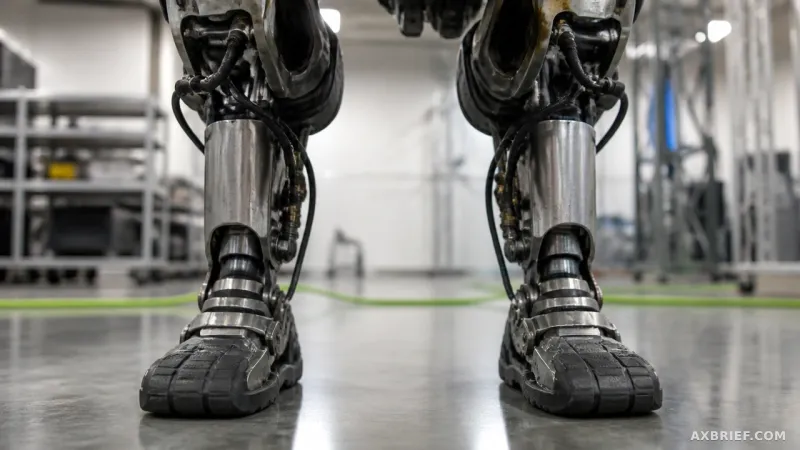
At the heart of the new Atlas design is a complete reimagining of the foot. While human feet are asymmetrical and designed primarily for forward propulsion, mechanical design engineer Chastity Kelly and her team opted for a strictly symmetrical structure. By placing the ankle joint exactly in the center of the foot, Boston Dynamics has provided the robot with a physical foundation that is agnostic to direction. This central alignment ensures that the robot's center of mass can be managed with equal efficiency whether it is moving forward, backward, or laterally.
This symmetry extends beyond the feet to the joints themselves. In a move that defies biological constraints, Atlas utilizes reversible knees. Human knees are hinge joints that bend in only one direction, forcing us to rotate our entire torso or adjust our stride significantly to move backward. Atlas, however, can flip the orientation of its knees. This reversible design allows the robot to transition between forward and backward movement without the need to rotate its entire lower body. In a cramped industrial workspace filled with machinery and obstacles, the ability to move in any direction without a wide turning radius is not just a convenience; it is a critical operational requirement.
By combining symmetrical feet with reversible knees, Boston Dynamics has effectively eliminated the concept of a front or back for the robot's legs. This hardware shift allows Atlas to perform complex maneuvers in place, minimizing the distance traveled and the energy expended during repositioning. The result is a machine that moves with a level of efficiency that would be impossible if it were merely mimicking human skeletal constraints.
Solving Software Complexity Through Hardware Compliance
While the skeletal structure provides the range of motion, the interface between the robot and the floor handles the physics of impact. Boston Dynamics implemented a dual-layer design, topping the mechanical structure with a specialized sole similar to a high-performance shoe. This sole is engineered to attenuate impact, absorbing the violent shocks that occur when a heavy humanoid lands from a jump. Without this dampening layer, the precision-engineered joints would be subject to rapid wear and catastrophic failure from repeated high-G impacts.
To tackle the challenges of slippery factory floors, the team developed a multi-directional tread pattern. Unlike human footwear, which is optimized for forward traction, Atlas's soles provide uniform friction across all axes. This ensures that when the robot shifts from a forward sprint to a lateral slide or an immediate reversal, the feet do not slip. The geometric design of the sole also supports a natural heel-toe transition, mimicking the efficiency of human walking while adding a mechanical advantage: the treads act as ejection ports for sand, liquids, and debris. By pushing foreign materials outward, the robot maintains a constant, high-friction grip even in dirty industrial environments.
This approach reveals a deeper philosophy in the development of Atlas: using hardware to solve software problems. In traditional robotics, achieving omnidirectional stability requires immense computational power to calculate complex rotations and balance corrections. By building a physically symmetrical and compliant system, Boston Dynamics has reduced the mathematical burden on the control team. When the hardware is inherently stable and capable of moving in any direction, the software no longer needs to calculate how to compensate for anatomical limitations. The physical structure handles the stability, leaving the software to focus on high-level task execution.
This balance is achieved through a rigorous cycle of CAD modeling and rapid prototyping. Chastity Kelly begins the process by simulating the geometry in a virtual environment, adjusting joint positions by the millimeter. These designs are then brought to life via 3D printing to create full-scale prototypes. When a prototype fails—perhaps a joint snaps or a crack appears under load—the team performs a root cause analysis to determine if the failure was due to material limits or a flaw in the geometry. This iterative loop continues until the hardware reaches the ideal level of compliance, where it is flexible enough to absorb energy but rigid enough to support the robot's weight without collapsing.
The evolution of Atlas demonstrates that the peak of humanoid robotics is not found in the perfect imitation of man, but in the optimization of the machine. By prioritizing machine-optimal geometry over biological mimicry, Boston Dynamics has created a platform that is more capable than a human in the very environments it is designed to serve. This level of precision is the product of deep interdisciplinary expertise, exemplified by Kelly's own journey from a GED to a PhD in mechanical engineering, including practical experience at Toyota. The ultimate utility of a humanoid robot does not depend on how smart the AI is, but on whether the hardware can physically manifest that intelligence without breaking. The stability of Atlas in the wild is a testament to the fact that in robotics, the most elegant code is often the one made unnecessary by brilliant engineering.